English story — Original Fiction
The Bell on the Third Floor
Estimated from scroll position, not proof that every word was read.
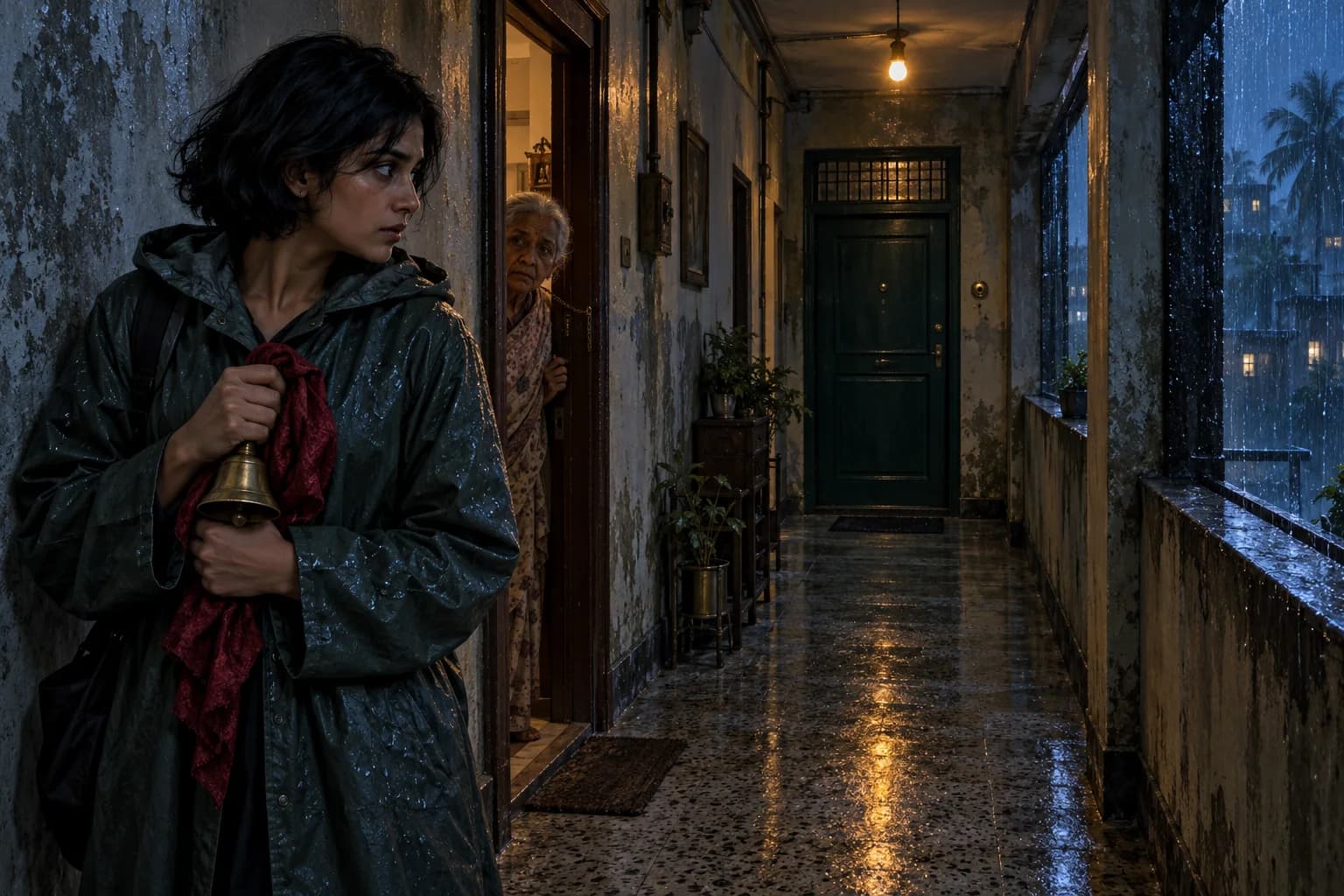
The first night, Naina blamed the wiring. Three rings, a pause, then two more. Flat 3B stood opposite her rented room, its green door chained through both handles. The electricity meter outside it had no display.
Her landlord had shown her the room that afternoon. He said the other flat was used for storage. He also said the roof never leaked. A saucepan under her bed was already proving him wrong about the roof.
At half past two, the bell rang again. Naina opened her door. The corridor smelled of wet plaster. No one stood outside 3B. She put her ear near the wood and heard something being dragged across a floor.
“Leave it,” said a voice behind her. An elderly woman in a yellow cardigan stood in the stairwell with a torch. “It stops if you leave it.”
“Who lives there?”
“Nobody who can open the door.” The woman went downstairs before Naina could ask what that meant.
By morning, the sentence sounded ridiculous. Naina worked night shifts answering delivery complaints; she knew what tired people could hear in ordinary sounds. She photographed the chained door and asked her landlord about it. He replied with a thumbs-up, then a message asking for the rent.
The second night, she recorded the bell. Three rings. A pause. Two rings. Underneath them, faintly, a woman counted. Naina played the recording at breakfast, but it contained only rain and her own breathing.
The woman in the cardigan was watering a plant on the ground floor. Her name was Mrs D’Souza. When Naina described the counting, the watering can tipped and spilled onto her slippers.
“She used to teach music,” Mrs D’Souza said. “The children rang three times. The parents twice. That was how she knew whether to put the kettle on.”
“What happened to her?”
Mrs D’Souza straightened the can. “A fire. Eleven years ago.” She looked at the building, not at Naina. “I heard the bell. I thought one of the children was playing with it.”
That evening, a small parcel waited outside Naina’s door. There was no address, only a brass hand bell wrapped in red cloth. The bell had no clapper. Inside the wrapping lay a folded sheet of music, browned at the edges. Written across it, in blue pencil: ANSWER WHEN I CALL.
Naina took the parcel downstairs. Mrs D’Souza shut her door as soon as she saw it. Through the wood, she said, “I put that in the river.”
Naina left the bell on the stairs. She packed a bag and booked a room near work. At the building entrance, her phone showed the booking cancelled. She tried another hotel. The screen filled with five missed calls from her own number.
Upstairs, the bell began. It was early; the street outside was still noisy. Three rings, a pause, two rings. A man carrying groceries walked straight past the sound. Naina caught his sleeve. “Can you hear that?” He glanced at her hand until she let go.
Mrs D’Souza came out with her torch. She was wearing a coat over her cardigan. “I tried to leave too,” she said.
“Then what do we do?”
The old woman picked up the brass bell. “I don’t know. I never answered.”
They climbed together. On the third floor, the air was hot. The saucepan in Naina’s room had stopped filling, although rain still struck the windows. Behind the green door, someone coughed. Then came a knock, so ordinary that Naina nearly knocked back.
Mrs D’Souza held out the hand bell. Naina shook it. Nothing. She shook harder. From inside 3B came one clear note.
The chain loosened. Its links dropped one after another onto the floor. Mrs D’Souza whispered, “I’m here.”
The door opened an inch. A strip of smoke rolled along the ceiling. Naina saw a chair on its side and the edge of a piano. A woman sat beyond it, facing the wall. The woman’s shoulders lifted with a breath.
“I heard you,” Mrs D’Souza said. “That night. I heard you and went back to bed.”
The woman turned her head. Naina did not see her face. She saw the open window behind her, and through it the corridor where they stood, repeated as if the flat had another door. In that other corridor, Mrs D’Souza was young. She closed her door. The bell rang.
Naina pulled the old woman back. The brass bell dropped. This time it made a sound on the tiles. The smoke vanished; the green door slammed shut. Both chains were in place.
Mrs D’Souza was crying without making a noise. Naina helped her downstairs and stayed until morning. At sunrise, they called a taxi. Their phones worked. No one rang from upstairs.
Naina never returned for the saucepan. A month later, her landlord sent a photograph of it and asked whether she wanted it posted. In the background of the photograph, her room was empty except for a new tenant’s suitcase.
A brass bell stood on the windowsill. This one had a clapper.
Behind the story — editorial note
The repeated bell ties the haunting to an unanswered call. Naina’s practical choices make the familiar apartment corridor unsettling without explaining away the final image.
My favourites (0)
Saved in this browser only. Clearing browser data removes them.
No favourites yet. Open a story and save it here.