English story — Original Fiction
The Last Offline Café
Estimated from scroll position, not proof that every word was read.
Chapters · 6
1. A cup without a receipt
At six minutes past midnight, the city stopped recognising Leena. The pharmacy door rejected her face. Her bicycle lock asked her to verify ownership, although she had ridden it for nine years. Then her wrist screen displayed a single line: IDENTITY UNDER REVIEW. She stood beneath an awning while rain soaked the medicine bag tied to her carrier. Upstairs, behind the pharmacy window, someone turned out the lights.
She had been carrying a parcel to her father. Nothing unusual: tablets, two oranges, a paperback with large print. The delivery app suggested that she return home and wait for review. When she selected her address, the map politely explained that no registered resident matched her details. A bus drew up beside her, opened its doors for three passengers, and closed them when she stepped forward.
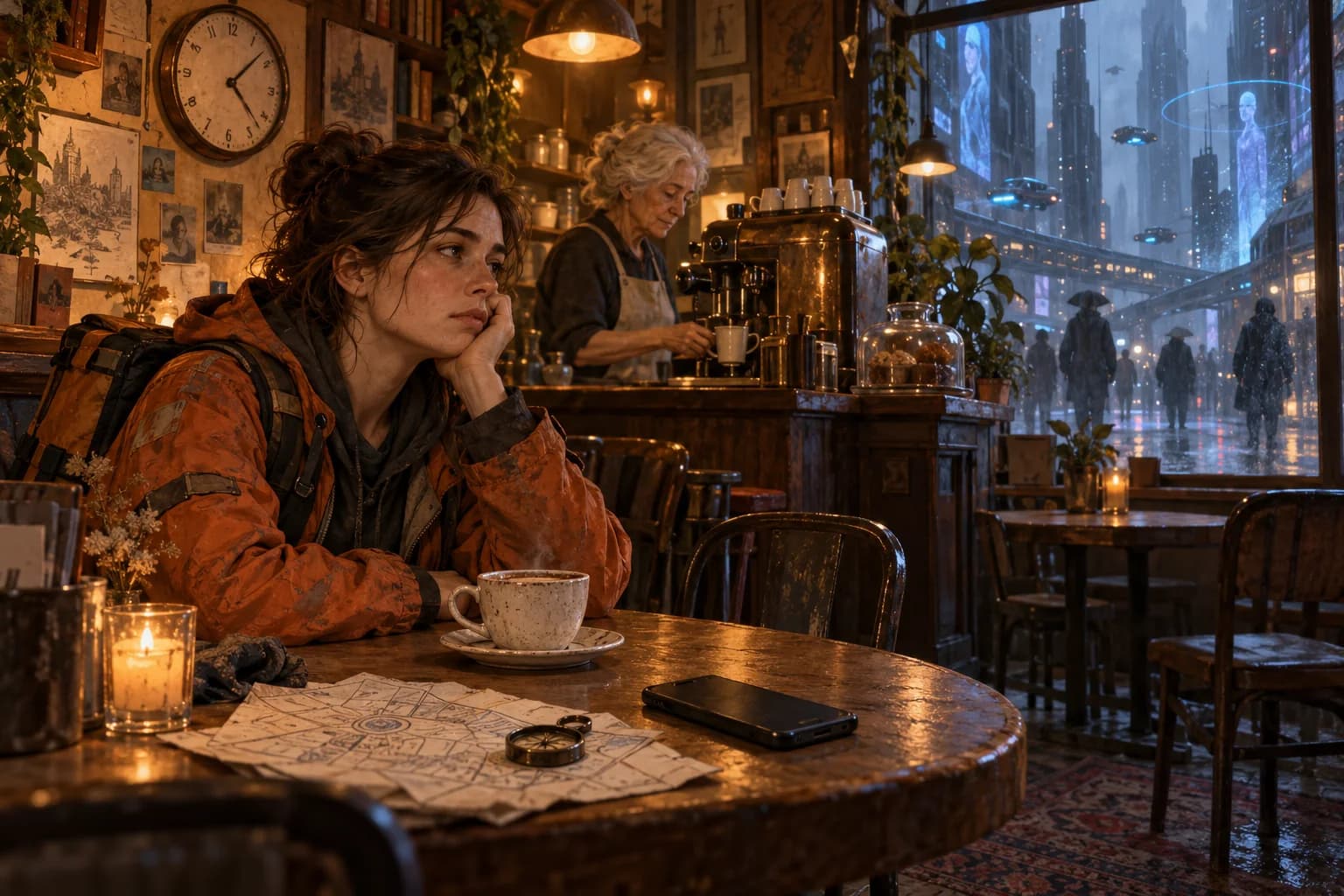
Across the road, a small café had a handwritten menu in its window. Leena could not remember the last time she had seen handwriting on a shopfront. There was no customer rating, no floating discount, no lens-readable price code. A woman with silver hair was washing a cup behind the counter. Leena pushed the door. It opened without asking who she was.
“Sit down before you drip on everything,” the woman said. She pointed to a towel hanging from a chair. “Coffee?” Leena lifted her wrist. The woman glanced at the message, then at her face. “I asked about coffee.” Her name, painted on a chipped badge, was Ada. She put a cup down and waited while Leena tried to explain that she could not pay.
“Tomorrow, then.” Ada took a pencil and wrote one word in a notebook: orange. Leena looked down at her jacket. “You keep debts by colour?” Ada shrugged. “People remember what they borrowed. Most of them come back.” Behind her, an old wall clock ticked loudly enough to be irritating. The minute hand moved. Nothing in the room moved in response.
Leena tried calling her father. Her wrist showed no signal. She walked towards the window, but Ada caught her sleeve. “Outside is connected. Inside is not. Choose.” Leena stood with one foot on either side of the threshold. A dozen alerts appeared. One asked her to confirm her employment history; another said her father’s visitor permissions had changed. She stepped back inside.
Ada locked the door. “That café has been closed for years, according to your map,” she said. “Useful mistake.” She took a folded paper from beneath the till and spread it on the table. It showed the district before the elevated roads were built. A narrow blue line ran from the café to the hospital where Leena’s father lived. Beside it somebody had written: service tunnel, south pump.
“Why are you showing me this?” Leena asked. Ada looked at the medicine bag. “Because the last person who came here with that message waited for permission to visit his daughter.” She wiped a ring of coffee from the table. “The permission arrived. The daughter had already died.” Leena stopped rubbing the towel over her hair. Beyond the glass, a street scanner turned slowly towards the café.
2. The woman the city forgot
Ada covered the window with a blind. The scanner’s blue light slipped through the gaps and travelled across their shoes. “It cannot see through the wall,” she said. “It can notice that someone went somewhere it cannot see.” Leena checked her wrist again out of habit. Without a connection, the last message remained perfectly still. She had never realised how often a screen changed simply to keep her looking.
“What did you do?” Ada asked. Leena said she had delivered parcels, visited her father, and worked an extra shift. Ada waited. Finally Leena mentioned a package she had refused that morning. A courier supervisor wanted her to mark a damaged battery as delivered. She had photographed the swollen casing and filed a safety report. The supervisor’s account had sent her a warning about repeated inconsistencies.
Ada opened a cupboard. Inside were notebooks, folded maps, spare shoelaces and a tin of coins. “One report may not be why,” she said. “But review systems reuse information. A bad employment signal becomes a payment warning. A payment warning becomes a travel restriction. Everybody asks everybody else whether to trust you. Nobody wants to be the first to say yes.” She put the tin on the table.
Leena knew the argument. She had read complaints like it online, then watched the complaints disappear beneath official replies. Now she wanted a simpler explanation, one person to telephone. “There has to be a desk.” Ada laughed, but not unkindly. “There is a desk. It uses the same identity system.” She offered Leena a pair of dry socks. They were different colours and far too large.
Ada had once designed municipal networks. Years earlier, a software merge had assigned her records to another woman with the same name. Their addresses and debts became tangled. Ada challenged it; the challenge was classified as an attempt to impersonate the other woman. She spent months trying to prove that she existed. Eventually she stopped paying the cost of every failed application and bought the café with paper money.
“You just gave up?” Leena heard the sharpness in her own voice. Ada looked at the clock. “Some days I call it that.” A shelf above the sink held a photograph of two young women beside an unfinished bridge. Ada turned it away when Leena noticed it. “I kept enough to make a life. I did not keep enough to visit everyone I wanted.”
A tapping came from the back door. Two taps, then a scrape. Ada opened it to a boy carrying bread. He was perhaps seventeen, with a patched waterproof cape and grease under his nails. “South pump is flooded,” he said. “Use the old laundry passage.” His name was Kit. He put the bread beside the till, saw Leena’s wrist, and gave her a look she disliked immediately: recognition mixed with pity.
Kit took a pencil and corrected the map. Leena studied his hands. No screen, no citizen band. “How do you work?” she asked. “For people who can pay with things,” he said. Ada gave him a loaf. He tore it in half and offered some to Leena. At the front door, something clicked against the lock. A calm recorded voice announced that a welfare check had been requested for a person inside.
3. Beneath the bright streets
The voice asked the occupants to step outside with their identification visible. Ada switched off the counter lamp. Kit lifted a square of floor behind the washing machine. Warm air rose from a ladder well, smelling of soap and old iron. Leena looked from the opening to Ada. “A welfare check is usually only a conversation.” Ada handed her the paper map. “Have one later. Your father needs those tablets now.”
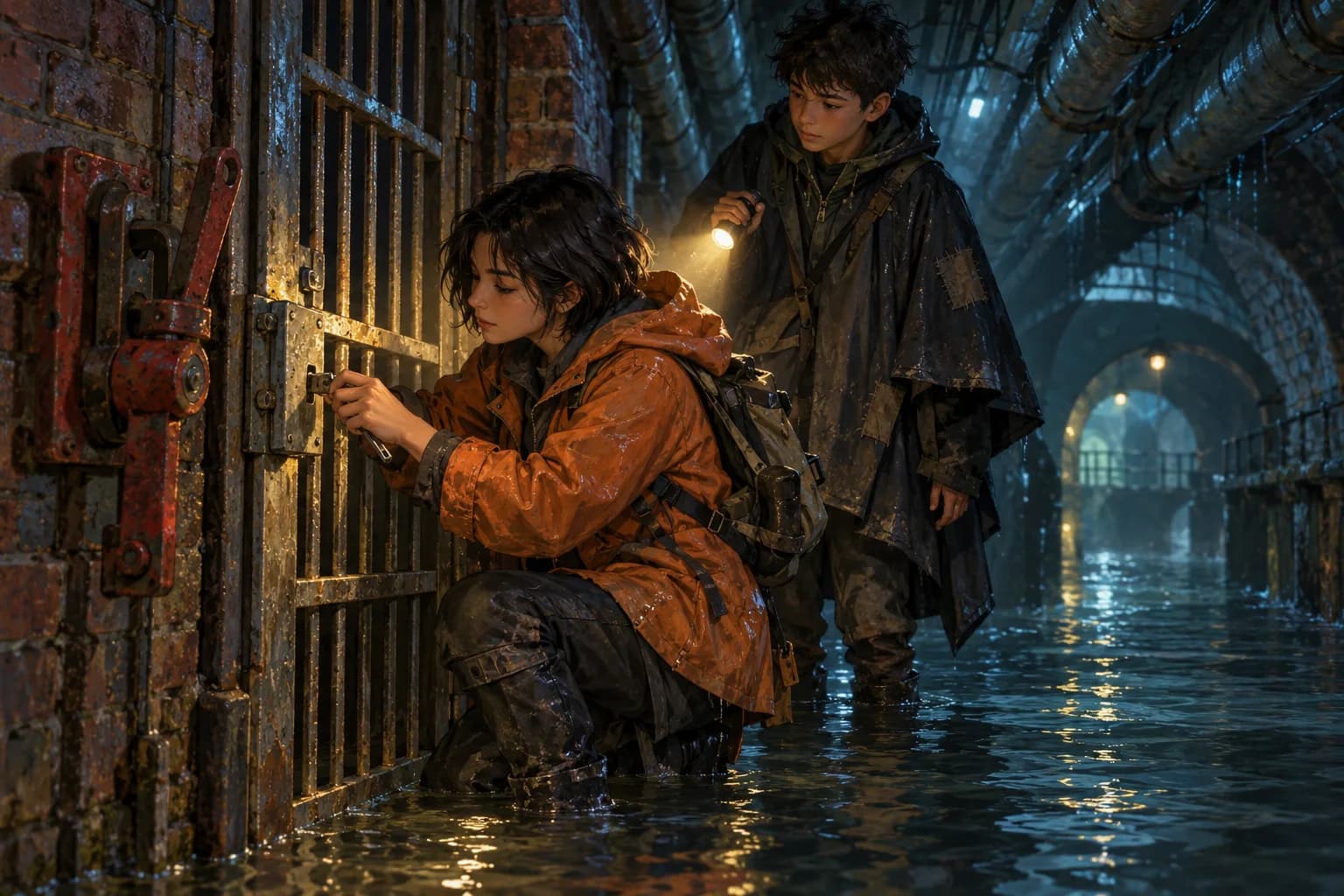
Leena climbed after Kit. The ladder shook under her weight. Above them, Ada replaced the panel, leaving a narrow strip of light that vanished when the washing machine rolled back. They waited in darkness. Kit switched on a small torch with a real button. Its beam found a brick passage carrying three generations of pipework. Their shadows stretched across the walls, bent and broken by valves.
“She should come too,” Leena whispered. Kit shook his head. “If the café is empty, they seal it. If she is there, she can argue.” He started walking. Leena followed, lifting her trousers above the water. The map had coffee stains and neat corrections in several different hands. Every tunnel turn was named for something ordinary: broken stool, red pipe, missing rung. None appeared on her city navigation service.
At the missing rung, Kit stopped. Across the passage, a gate blocked the way. Its old mechanical padlock had been replaced by a bright connected latch. Kit swore softly. Leena held up her wrist; even underground, the latch flashed when it detected her. A speaker asked her to remain nearby. She stepped back. The latch continued flashing. Kit pointed to a cable running through the wall. “They remembered this tunnel after all.”
They could go around, he said, but it would take another hour. Leena thought of her father setting out two cups in his hospital room, although she always arrived late and the tea always cooled. He had been a tram driver before the city automated the lines. When the hospital asked for a family contact, he had insisted on using her name, not the name of a monitoring service.
Leena examined the latch. It was the same model used on delivery lockers. The battery units were replaceable from the outside so couriers could service them without permission to open the compartment. She took her bicycle tool from her pocket and unscrewed the casing. Kit held the torch. Inside, a swollen cell pressed against the wiring. She recognised the shape from that morning’s parcel.
Removing power did not open the gate. It released a small red lever marked for maintenance. Leena pulled it; Kit lifted the locking bar. The gate moved with a long, complaining scrape. On the casing, a tiny light continued to blink. “Backup cell,” Leena said. “It recorded that.” Kit squeezed through. “Then we should be gone before it tells anyone.” She left the unsafe battery on a dry ledge, away from the water.
The hospital’s laundry stairs were warmer than the tunnel. Halfway up, they heard wheels overhead and a porter humming. Kit stopped at a side exit. He would not come further; hospitals logged every face. Leena offered to repay him when her account worked. He pressed the map into her hands. “Bring this back. There are people who need it after you.” Then he climbed down into the dark.
4. Visiting hours
The laundry porter looked at Leena’s wet trousers, then at the bag of medicine. His name badge said Rafi. “Visitors use the front entrance,” he said. She told him her father’s name and room number. Rafi looked towards a ceiling camera. “I cannot let you through.” Leena did not argue. She asked whether he could carry the bag upstairs. He hesitated, then nodded. “Write the name clearly.”
She wrote it on the café map because she had no other paper. Rafi waited while she carefully tore a blank corner from the edge. The tiny act felt worse than forcing the gate. Somebody had drawn that map to last. He took the bag and disappeared through the swing doors. Leena sat beside a basket of clean sheets. A machine counted items, clicking with each sheet that passed its scanner.
When Rafi returned, her father was with him in a wheelchair. Dev wore his old tram-company cardigan over hospital pyjamas. He looked smaller than he had last week. “You could have called,” he said, then saw her wrist and stopped. Leena knelt beside the chair. His hand was warm. For the first time that night, the trouble felt like something that could be told rather than something that had to be outrun.
Dev listened without interrupting. When she finished, he asked Rafi for tea. “That is all?” Leena said. “You are sitting with me,” he replied. “I would like tea.” Rafi brought three paper cups. They drank beside the laundry basket while Leena’s father unfolded the map. At Ada’s name, his finger stopped. He asked where she had got it. Leena described the café. His face changed before he said anything.
Ada had been his wife’s sister. Leena remembered an aunt who sent drawings of machines on birthday cards, then vanished after an argument nobody explained. Dev had tried to find her through public records. Her messages arrived tagged as possible fraud, and he stopped opening them. Later he learned the records were wrong. By then her address had disappeared. “I thought she did not want to be found,” he said.
Leena stared at the corner she had torn from the map. Upstairs somewhere, a door alarm sounded, followed by an announcement about a visitor review. Rafi set down his cup. He could get into trouble, he said. Dev nodded. They had no right to make him choose between kindness and his job. He asked Rafi to take him back. Before he left, he wrote a message beneath the map’s coffee stain: I am still here. Please come.
At the laundry exit, a wall screen showed Leena’s photograph. It described her as a person requiring assistance, not as someone accused of anything. Below it was a notice that linked a recent infrastructure incident to her review. The gate had reported its broken seal. Rafi pointed down the stairs without looking at her. Leena folded the map and went. She heard his wheels rolling towards the lift after the door closed.
Outside the passage, Kit was waiting. “They are at the café,” he said. His cape had torn at one shoulder. A small camera drone circled the laundry courtyard above them. Leena took off her wrist band. Kit caught her hand before she threw it away. “They know where it stops.” She looked at the band, at the drone, then at the hospital. “Good,” she said. “Perhaps for once I can decide what it tells them.”
5. The open door
At a public information post, Leena connected the band. Questions appeared immediately. She selected assistance, then a human operator. A queue estimate began at forty-seven minutes. She kept the connection alive while Kit searched for an ordinary phone. “What if it sends someone?” he asked. Leena pointed to the post. “Then they come here.” She would not lead another scanner to the café door. That much she could still choose.
Kit found a night cleaner with a wired handset in a service booth. The cleaner listened to their explanation, scratched his beard, and asked who would be paying. Kit handed over the remaining half of his loaf. Leena called the café number printed in small letters on the map. Nobody answered. She tried again. On the fourth attempt, Ada picked up. Behind her, a man was reading a list of alleged safety failures.
“Do you know Dev?” Leena asked. The silence lasted so long she checked the receiver. Then Ada said, “I knew a Dev.” Leena read her father’s message exactly as he had written it. She heard a cup hit the floor. Ada asked which hospital. Leena told her, and Ada said the room number before Leena could. She had been watching the public transfer notices for years, never certain whether the man named there was family.
Ada said the officers wanted to inspect the floor. There was no point pretending the tunnel was hidden now. They had photos of Leena entering the café and records from the gate. “You should leave,” Leena said. Ada gave a small, tired laugh. “I think I have been doing that for a long time.” She asked for the handset number. Then she put down the phone without saying goodbye.
A human operator finally answered Leena’s queue. He asked for her verified identity before he could access the case. She began to laugh, then stopped herself. “Please write that down,” she said. “I am calling because verification does not work.” He sounded embarrassed. There was a manual incident form, he admitted. He could record the call without resolving her identity. It would not restore anything tonight. Leena told him to open it anyway.
She gave him the damaged battery serial number from memory, the supervisor’s warning, and the time of the restriction. When he said an infrastructure incident complicated the case, she described the swollen cell behind the gate. There was a maintenance camera; he could ask for the footage before it was overwritten. She made him repeat the case number. Kit wrote it on his wrist with Ada’s pencil. Neither trusted a number held only on a connected screen.
The service booth phone rang. Ada was at a district safety office with two officers. She had asked for a transport permit to the hospital and offered to accompany their inspection after visiting Dev. They would not grant it. Leena passed the phone to her operator and kept both lines open. For several minutes she stood uselessly between two conversations. Then the operator said he could record a witnessed family-access request against the same incident.
Nothing opened automatically. An officer had to telephone the hospital; the hospital had to find Dev; Dev had to say aloud that Ada was his sister-in-law and he wanted to see her. There were mistakes, repeated names, and a long argument about who would sign. Leena’s queue connection expired once. She called back with the case number. At dawn, a transport permit printed from the information post, smudged along one edge. She held it with both hands.
6. A table for three
Ada arrived at the hospital in an official car, carrying a paper bag of bread. An officer walked beside her. Leena waited at the service entrance, where Rafi had just finished his shift. He saw the permit and smiled without touching it. The three of them rode the lift together. Ada kept smoothing the bag. When the doors opened, she stopped. “I do not know how to start,” she said. Leena pointed down the corridor. “He wanted tea.”
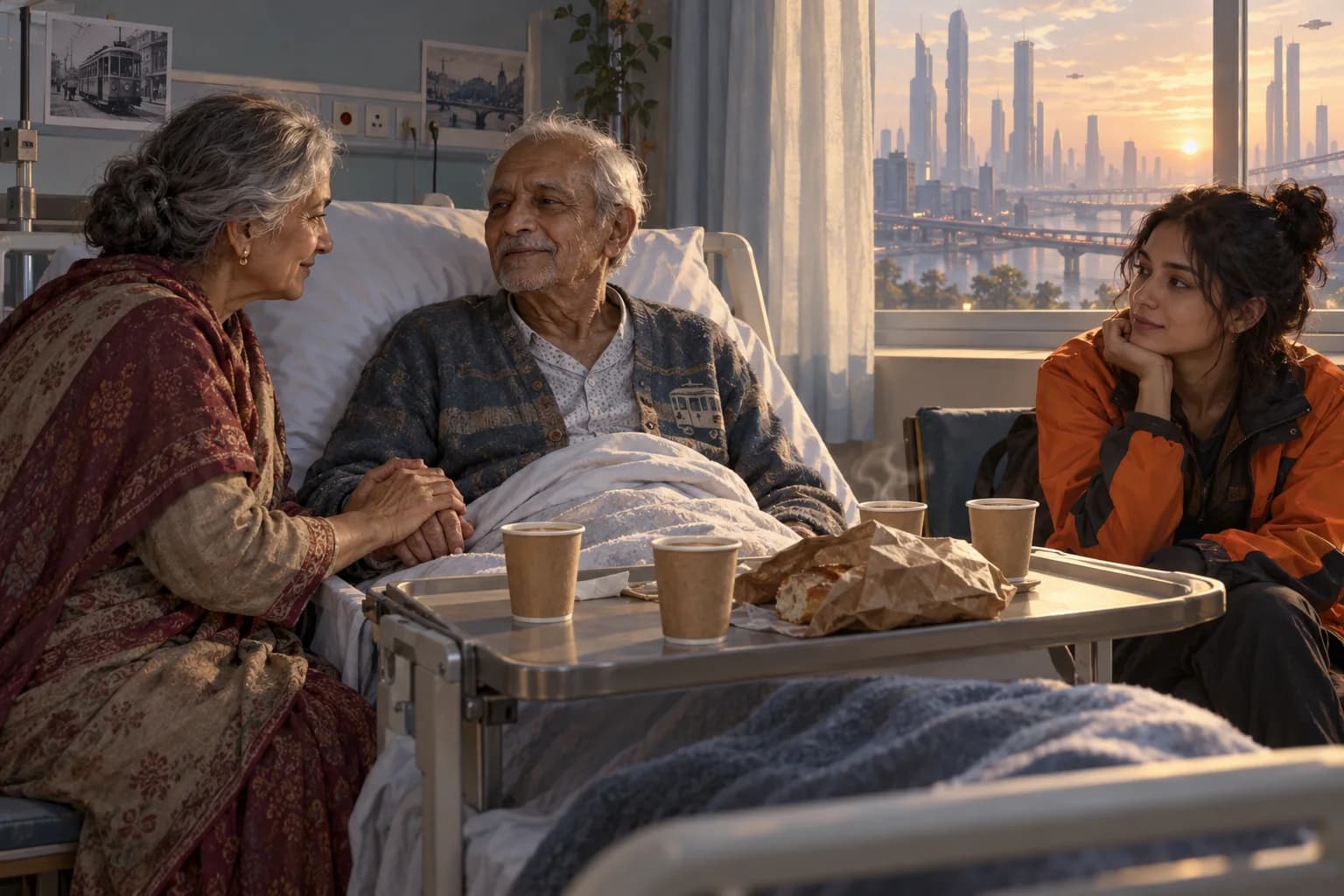
Dev was sitting upright with two cups on his tray. He had ordered a third from the nurse. Ada stood in the doorway. “You got old,” she said. “You took your time,” he answered. For a moment Leena feared they would spend the visit on another argument. Then Ada put the bread down, and Dev reached for her hand. Neither apologised in a way that could fit neatly on a form. They began with the people they had lost.
The officer waited outside. Leena sat near the window while her aunt told her father about the café, about Kit, about the names she had stopped using. Dev described the empty tram depot and Leena’s first disastrous bicycle delivery. Ada laughed at the right detail: she had given Leena that bicycle. Leena had forgotten. She looked at the orange sleeve drying on the radiator and realised how much family history had become scattered messages she never opened.
Her account did not return that morning. The investigation took eleven days. During that time she borrowed a bicycle with a mechanical lock, ate at the café, and visited the hospital on written permissions. Some officials accepted the paper immediately. Others asked for a digital version of the paper that explained why she could not use a digital version. She learned to keep spare copies and to say the same sentence without raising her voice.
The café was closed for four days after its inspection. Ada paid for a new electrical fuse board and had to remove the loose stair cover behind the washing machine. The service tunnel was marked as a restricted maintenance route. Kit was furious; several people had used it to avoid the same review trap. Ada did not tell him to be grateful. She helped him mark the routes still open, then called Leena’s operator to ask what visitors were supposed to do instead.
Eventually, a small hospital desk began accepting witnessed identity disputes. It was not a citywide solution. It was two clerks, a telephone and a cabinet that jammed when it rained. People still waited too long. Leena went once a week to help explain the forms. She could not promise that anyone would be cleared. She could say where to ask, what to write down, and that a review message was not the same thing as a person.
When her wrist displayed IDENTITY RESTORED, she was peeling an orange at her father’s bedside. She waited for a grand feeling of relief. Instead, she finished peeling it and gave him half. Outside, the city’s advertisements adjusted themselves to recognise her again. Inside, Dev and Ada argued over whether the café should serve lunch. He wanted soup. She said a man who complained about hospital soup had no right to suggest it to paying customers.
A month later, Leena returned to the café with a replacement map drawn on waterproof paper. Ada inspected it and added one correction: the hospital desk now closed at six. Beside the till sat a new ledger, already crowded with colours, names and small debts. Leena offered to make a payment system for it. Ada gave her a look. Leena laughed and took out a pencil. Under orange, she wrote: paid. Then she added three cups of tea.
Behind the story — editorial note
A delivery worker’s blocked account becomes a barrier to ordinary life. The café and paper route offer human help, while the larger system takes time to repair.
My favourites (0)
Saved in this browser only. Clearing browser data removes them.
No favourites yet. Open a story and save it here.