English story — Original Fiction
The Unfinished Sentence
Estimated from scroll position, not proof that every word was read.
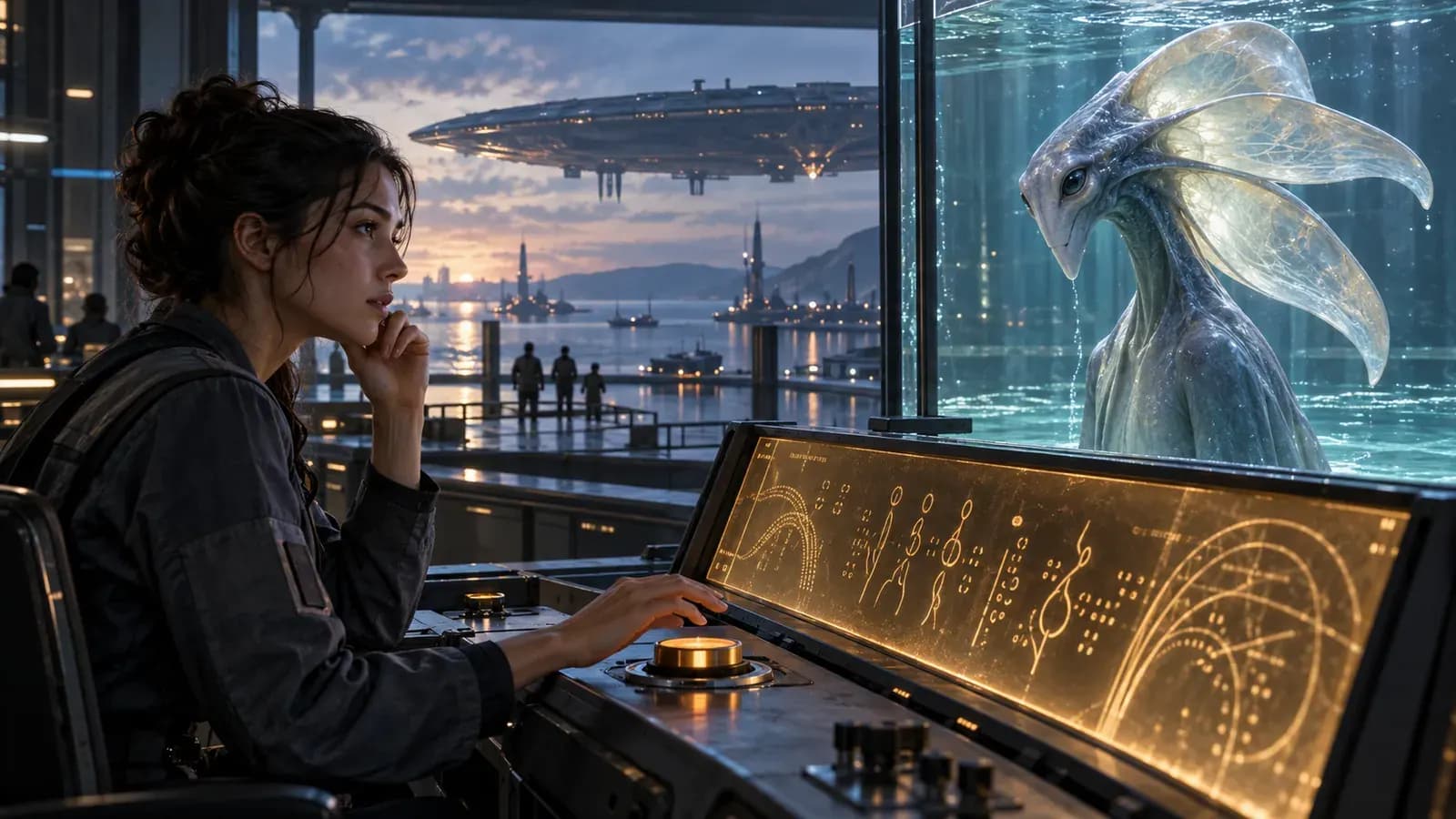
The translation appeared before the visitor had finished speaking.
WE HAVE COME TO SURRENDER.
Behind the glass, someone began to applaud.
Maren kept her hand above the broadcast switch. The sentence was amber. Confirmed translations were white.
“Send it,” said the governor.
“The system is still predicting.”
“It has predicted correctly for six months.”
“For weather reports and docking instructions.”
The visitor stood in a shallow tank at the centre of the room. Beneath its transparent collar, three pale membranes moved against one another. It had been speaking for nearly a minute.
The governor leaned towards his microphone.
“On behalf of the settlements, I accept.”
Maren cut his channel.
He turned slowly.
Outside, beyond the observation window, the visiting ship hung over the harbour. Every defence tower faced it. Its arrival had interrupted the governor’s speech marking forty years since the first human landing.
The amber sentence expanded.
WE HAVE COME TO SURRENDER OUR CLAIM—
Then it stopped.
“The pause is part of the language,” Maren said.
The governor pointed at the screen. “Our claim. There.”
A technician at the back raised two fingers. The military channel wanted permission to transmit.
Maren shook her head.
The visitor pressed one limb against the tank wall. A ring of colour passed through its body, blue fading to a dull silver.
On her private display, Maren opened the raw translation record. Each prediction had been drawn partly from the previous exchange.
Docking permission.
Territorial boundary.
Recognition of authority.
The governor had supplied most of the vocabulary.
She disabled predictive completion.
The large screen went blank.
“Put it back,” he said.
“I’ve left the translation running.”
“You’ve removed the translation.”
“I’ve removed the words it hasn’t heard yet.”
For ninety seconds, nobody spoke.
The visitor’s membranes continued moving. A bead of water travelled down the outside of the tank. Maren watched it reach the floor.
Then white letters appeared.
WE HAVE COME TO SURRENDER INTO YOUR CARE THE PEOPLE YOU LEFT WITH US.
The governor looked towards the ship.
“What people?”
Maren opened his microphone.
The reply took four minutes.
During the first landing, a survey vessel had disappeared beyond the northern ice. Search teams had found a broken antenna. The visitors had found the crew.
Eleven people had survived.
They had lived there for thirty-eight years.
“Why didn’t you bring them back?” the governor asked.
The visitor’s reply was shorter.
YOU DID NOT RETURN.
On the screen behind Maren, the prepared broadcast still read: HISTORIC AGREEMENT SECURES HUMAN SOVEREIGNTY.
She closed it.
The ship carried nine sealed containers and two living passengers. Both had asked whether there were still apple trees near the harbour.
Maren remembered the small orchard behind the customs building. Last week, someone had proposed clearing it for parking.
The governor began another question, then stopped.
The visitor lifted a flat object from beneath the water. Eleven names appeared on its surface, written in a careful, unfamiliar version of human script.
Maren switched on the recording channel.
“Please,” she said. “Start with their names.”
This time, she waited.
Behind the story — editorial note
Maren waits for the speaker to finish instead of treating a prediction as an agreement. The cover is an AI-generated illustration of the fictional scene.
My favourites (0)
Saved in this browser only. Clearing browser data removes them.
No favourites yet. Open a story and save it here.